
Skip to main navigation menu Skip to main content Skip to site footer

Journal of Creative Perspectives

About

The Journal of Creative Perspectives (JCP) is a multi-disciplinary, open-access scholarly journal dedicated to advancing research, innovation, and critical discourse across the fields of art, architecture, design, visual culture, UI/UX, visual communication, cultural heritage, tourism, and creative and cultural management.

JCP serves as a platform for both scholarly research and creative works, including critical analyses, design research, practice-based studies, user interface and user experience design research, and visual essays. The journal aims to bridge theory and practice by featuring a diverse range of research articles, reviews, and creative and critical contributions that reflect emerging trends shaping the evolving creative and cultural landscape.

Through peer-reviewed research, JCP seeks to inspire scholars, practitioners, and students to engage with the intersections of creativity, culture, design, heritage, tourism, and management, fostering dialogue across academic and practice-based fields.

JCP is a fully open-access journal and does not charge any submission or article processing fees (APCs).

If you have any questions or encounter any issues during submission, please contact us by email. You may also connect with us on LinkedIn.

ISSN: 2944-6163
Location: Hamburg, Germany

Read More

Announcements

  • 2026-08-04

    Submissions Are Open for the October 2026 Issue

    The Journal of Creative Perspectives (JCP) is pleased to announce that submissions are now open for the October 2026 Issue.

    We welcome original contributions from researchers, academics, practitioners, designers, artists, and creative professionals working across interdisciplinary fields. This issue particularly encourages submissions related to:Design, Heritage and Art.


  • 2026-04-09

    Submissions Open for June 2026 Issue of JCP

    Submissions Open for June 2026 Issue of JCP

    The Journal of Creative Perspectives (JCP) invites submissions for our upcoming Summer issue, publishing at the end of June 2026. Continuing our mission to champion interdisciplinary research, we welcome original papers that explore the intersections of creativity, society, management, tourism, urban studies, and user experience (UX).

    We are seeking theoretical, empirical, and practice-based contributions that examine how creative approaches drive social transformation, shape sustainable environments, and foster inclusive design. We particularly encourage case studies and collaborative research that bridge the gap between academic theory and practical application. 

Current Issue

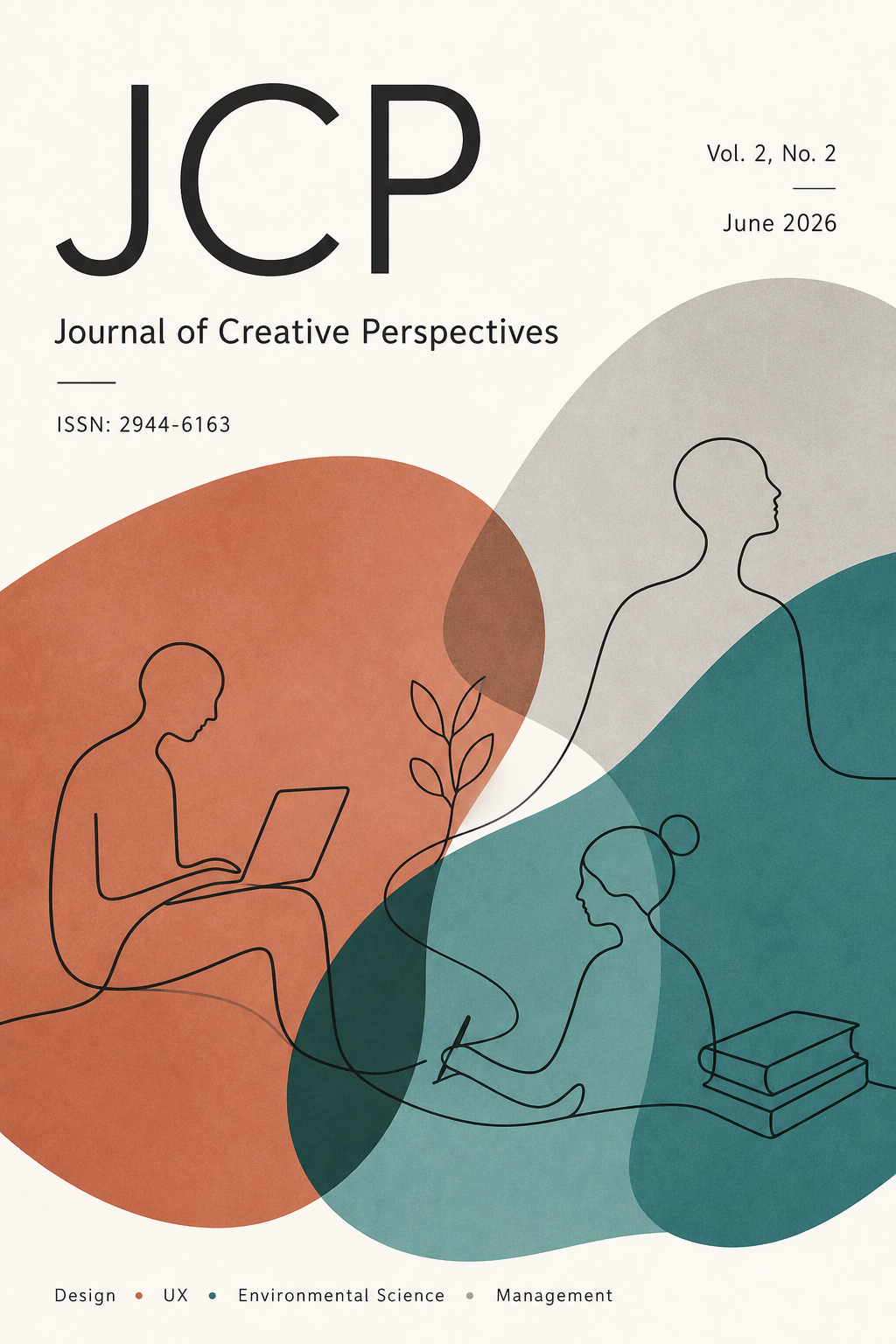
Volume 2, No. 2Design • UX • Environmental Science • Management

Published June 30, 2026

Issue description

The second issue of Volume 2 of the Journal of Creative Perspectives presents a diverse collection of research that reflects the breadth of contemporary design thinking. The contributions gathered here examine how design — in its spatial, systemic, digital, and stra ... See the full issue

Research Articles

  1. Interactive and Inclusive: Gamified Learning for Healthy Eating in Community Kitchen Entertainment Areas

    Community kitchens, in addition to being spaces that increase the availability of food, are also important spaces for promoting sociality and health education. By incorporating gamification and fun elements, they can make learning about food and healthy food preparation more interactive and fun. This study investigates how entertainment space within a community kitchen employs gamification to promote social interaction alongside healthy eating habits and disordered eating behavior management. It examines the ways of approaching the use of gamified processes alongside communal engagement, in an effort to make sustainable, healthy practice lifestyle viable.

  2. Export or Die? Why Nigerian Designers Ignore Global Markets While Importing $1.5 Billion of Foreign Goods

    Nigeria annually imports consumer goods, furniture, ceramics and manufactured products valued at approximately $1.5 billion, a figure that coexists paradoxically with a large, formally trained community of industrial designers and applied arts practitioners who remain substantially absent from global export markets. This paper investigates the structural, institutional and perceptual barriers that explain this paradox, drawing on primary survey data from 45 design educators, practitioners and students across 18 Nigerian states. The study finds that only 6.7% of respondents identified export and global market access as the most significant future trend for Nigerian design — a figure that stands in sharp contrast to the scale of the import dependency problem. Analysis of challenge indicator data, qualitative policy narratives and sustainability integration profiles reveals a sector constrained by infrastructure deficits, funding scarcity, weak policy frameworks and an inward-looking educational culture. Drawing on export readiness theory, creative economy frameworks and the resource dependence perspective, the paper argues that export disengagement is not a preference but a structural outcome of accumulated institutional neglect. It connects directly to companion findings on physical infrastructure deficits documented across the same 18 states (Morakinyo et al., 2026), establishing that the workshop and the world market are separated by the same underlying failures. The paper recommends a national design export strategy, accreditation-linked infrastructure investment and curriculum reform oriented towards global competitiveness.

  3. Addressing Social Isolation in Student Life: A Service Design Proposal for a Cross-Institutional Student Hub in Hamburg

    Rising levels of stress, anxiety, and loneliness among students are increasingly linked to social isolation and limited opportunities for meaningful interaction. This study explores how gaps in student social infrastructure impact wellbeing and examines the potential of service design as a preventive intervention. Drawing on literature in mental health, social design, and youth wellbeing, alongside qualitative interviews with students and a student engagement professional, the research identifies key barriers to social participation, including time constraints, cultural and language differences, and limited visibility of existing initiatives. 

    Findings suggest that current social opportunities are fragmented, institutionally bounded, and often fail to support sustained, low-pressure interaction. In response, the study proposes a city-wide Student Hub in Hamburg, designed to foster belonging through shared routines, activity-based engagement, and inclusive participation. The concept integrates spatial, temporal, social, and digital elements to support autonomy, competence, and relatedness. The research highlights the role of accessible social infrastructure in promoting preventive mental wellbeing and emphasizes participatory design as a key factor in creating inclusive student communities. 

  4. Addressing the Lack of Belonging among students in Hamburg Through Activity-based Spatial Design

    Large cities with several universities often promise diversity and connection, but in practice student life is frequently shaped by institutional boundaries. In Hamburg, even though universities are geographically close and student populations are diverse, meaningful interaction across institutions remains limited. This situation can be particularly challenging for international students, many of whom experience social isolation and difficulties forming connections beyond their own university. This research explores the idea of a cross‑university Student Hub as a shared space and service designed to support social integration and strengthen students’ sense of belonging. The study uses a mixed‑methods approach, combining environmental observation, an online survey (n = 30), and semi‑structured interviews with three international students. Together, these methods helped identify barriers to cross‑university interaction and revealed how existing student spaces are experienced. The findings show that current spaces are often seen as fragmented, restricted to single institutions, and lacking activities that encourage social interaction. Students consistently highlighted the importance of structured activities, low‑pressure social settings, and inclusive environments that make it easier to engage without feeling overwhelmed. Drawing on Student Integration Theory and Social Identity Theory, the research translates these insights into a service design proposal for a cross‑institutional Student Hub that prioritizes accessibility, affordability, and regular social programming. The proposed intervention aims to support gradual engagement, foster cross‑cultural connections, and make belonging something students can experience rather than abstractly define. While the study is limited by its sample size and context, it demonstrates how service design can respond to social isolation in higher education and offers a strong foundation for future pilot testing and long‑term evaluation.